Most highway teams don't have a data problem. They have a workflow problem.
Finding defects has never been easier. Fixing them efficiently is another matter.
Across the highways sector, organisations are collecting more network data than ever before. AI inspections, condition surveys, imagery and asset data are providing unprecedented visibility of what's happening on the network.
But visibility alone doesn't improve roads. A pothole isn't repaired because it was detected. A drainage issue isn't resolved because it appeared on a dashboard. Value is only created when information moves quickly and reliably from identification to action. And that's where many highway workflows still break down.
Data sits in one system. Decisions happen in another. Work orders are manually created somewhere else. Teams spend valuable time transferring information between platforms instead of focusing on maintaining the network.
At the same time, the industry is being encouraged to embrace new approaches. The introduction of PAS 2161, alongside wider government support for AI-enabled infrastructure management, reflects a clear direction of travel: more consistent data, greater transparency and better use of technology to tackle growing maintenance challenges.
The reason is simple. Councils and contractors are facing increasing pressure to manage ageing assets, rising public expectations and significant repair backlogs with finite resources. Better data is part of the answer — but only if it leads to faster, smarter decisions.
The future isn't simply better inspections. It's better integration.
Because the most effective highway operations don't treat surveys, asset management and maintenance as separate activities. They treat them as one connected workflow.
So what does a truly integrated highway workflow actually look like in practice?
The Problem is Not Collecting Data
The highways sector isn't short of data. In fact, organisations are collecting more information about their networks than ever before. AI inspections, condition surveys, asset inventories and imagery are providing unprecedented visibility of road condition and network performance. The challenge is what happens next.
Too often, valuable inspection data becomes trapped in disconnected systems, spreadsheets and manual processes. Defects are identified, but action is delayed. Teams spend time moving information between platforms rather than prioritising repairs and managing risk.
This challenge is becoming increasingly important as authorities face growing pressure to do more with less. The backlog of carriageway repairs in England and Wales now stands at billions of pounds, while councils continue to balance ageing infrastructure against constrained budgets.
“£16.81 billion is now reported to be needed, as a one-off, for local authorities to bring the network up to their ‘ideal’ conditions and the work would take 12 years to complete. In the last decade this backlog figure has increased by 42% from £11.8 billion reported in ALARM 2016.” Annual Local Authority Road Maintenance Survey Report, 2025.
At the same time, PAS 2161 and wider government support for AI-driven monitoring are accelerating the adoption of new inspection technologies. The focus is rightly shifting towards better data, more frequent network coverage and greater consistency. But better data alone doesn't fix roads.
The wider public-sector context matters here too. The Government’s 2025 State of digital government review found that only 27% of respondents believed their current data infrastructure gave them a comprehensive view of operations, while 70% said their data landscape was not well coordinated, interoperable, or capable of providing a unified source of truth.
The same review said councils often struggle to make systems interoperable because of legacy suppliers and the perceived high cost of APIs, and that digital and data roles account for only 2% of headcount in local government against a 4% benchmark. For highway teams already under pressure, that means new technology has to reduce manual steps, not add more of them.
That's where integration becomes critical. Because the real measure of success isn't how much data you collect. It's how quickly and effectively you can turn insight into action. The organisations seeing the greatest value from AI aren't simply collecting more information. They're creating connected workflows that move seamlessly from inspection and identification through to work order creation, repair and reporting.
What an Integrated Highway Workflow Actually Looks Like in Practice
A successful survey-to-repair workflow isn't defined by how much data is collected. It's defined by how quickly that data turns into action.
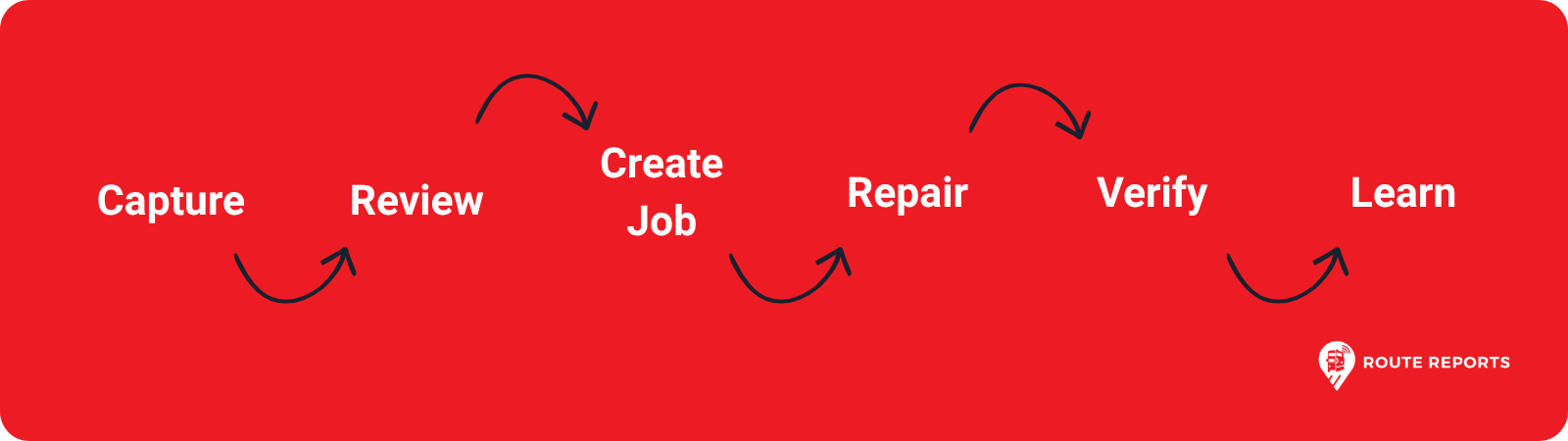
In practice, the process is straightforward:
- Capture – Data is collected across the network through routine operations.
- Review – Findings are assessed against local policies and risk thresholds.
- Create – Validated defects are automatically transferred into the work management system.
- Deliver – Repairs are planned, assigned and completed.
- Learn – Completion records and reinspection evidence feed back into the asset record.
Simple in theory. The challenge is that most inefficiency sits between these steps.
Data is captured but often not reviewed quickly enough. Defects are validated but manually re-entered into another system. Repairs are completed but evidence is stored elsewhere. Each handoff introduces delay, duplication and the potential for information to be lost or errors made. This is where integration changes the picture.
Modern platforms, like Route Reports, can now automate the flow of information between survey, asset and maintenance systems. Route Reports’ PAS 2161 accredited platform uses AI, computer vision and vehicle-mounted cameras to detect potholes, cracking, signs, lines and other highway defects at scale. More importantly, the resulting data can flow directly into operational workflows rather than sitting in standalone reports.
The review stage remains critical. National guidance continues to emphasise a risk-based approach to inspections and maintenance decisions. The objective isn't to overwhelm teams with detections; it's to provide reliable, evidence-based information that supports local priorities and engineering judgement.
The most effective workflows therefore combine AI-driven data capture with human expertise. Technology identifies what needs attention, while highway professionals determine what action should be taken. That's when inspection data stops being a survey output and starts becoming a maintenance workflow.
Why an Export File is Not an Integration
This is where many organisations get caught out. An export, emailed report or standalone dashboard might move data from one place to another — but that doesn't make it an integration.
True integration connects workflows, not just systems.
The distinction matters because every manual step creates friction:
- Data is exported.
- Someone reviews it.
- Someone manually creates a job.
- Someone else updates progress separately.
Before long, delays, duplication and data quality issues start creeping in. In highways, where inspection data needs to lead quickly to action, those gaps can become costly. A simple way to think about it is this: An export tells you what was found. An integrated workflow helps ensure something gets done about it.
The best highway workflows don't stop at defect detection. They connect inspection platforms, asset management systems and works management systems into a single operational process.
That's why integration with platforms such as Brightly Confirm, Symology and other operational systems is so important. When a defect is identified, the right information can flow directly into the systems teams already use to plan, assign and track repairs. And just as importantly, information should flow back the other way.
A completed repair, inspection outcome or status update becomes part of the asset's history, creating a continuous record that supports future maintenance decisions.
This principle isn't unique to highways. As TechRadar notes when discussing digital integration:
"If a conversation begins in web chat, moves to a phone call and later continues on WhatsApp, that context should follow the customer throughout the journey."
The same principle applies here. Defect data, maintenance decisions and repair outcomes should follow the asset throughout its lifecycle. Because highway maintenance isn't a series of isolated activities. It's a connected process.
And as the use of AI continues to grow, the organisations seeing the greatest value won't be those collecting the most data. They'll be the ones that have joined the dots between insight, action and delivery.
What This Looks Like in Confirm, Symology and Other Systems
The principle is simple: inspection data should arrive in the systems teams already use.
Whether that's Brightly Confirm, Symology Aurora or another works management platform, the
objective is the same — eliminate unnecessary manual steps between identifying a defect and creating and tracking the progress of a repair.
Route Reports integrates with both Brightly Confirm and Symology, allowing validated inspection data, imagery and defect information to flow directly into existing workflows. And because no two authorities operate exactly the same way, bespoke integrations can also be developed where required. The goal isn't another system to manage. It's helping existing systems work together more effectively.
Why the Closed Loop Matters
Creating a repair is only half the story. The real value comes when completion records, inspection outcomes and historical imagery flow back into the asset record, creating a continuous evidence trail.
This supports better maintenance decisions, stronger auditability and more informed investment planning over time. It also enables virtual re-inspections, faster responses to resident enquiries and greater confidence in what's happening across the network. The most efficient highway workflows don't stop when a job is completed, they learn from every intervention.
The Next Step for Highway Teams
Most authorities don't need more survey data. They need fewer gaps between capture, validation, work ordering, delivery and verification. The question is no longer whether AI can identify defects. The question is how efficiently those insights move through the maintenance process and into action.
At Route Reports, we've built our platform around that principle. By combining PAS 2161-accredited inspections, virtual re-inspection capabilities and integration with systems such as Brightly Confirm and Symology, we're helping councils and contractors create connected workflows that reduce friction and improve decision-making. Because ultimately, the value of a survey isn't what it finds. It's what happens next.
Ready to Move from Survey to Repair?
The value of inspection data isn't what it finds — it's what happens next.
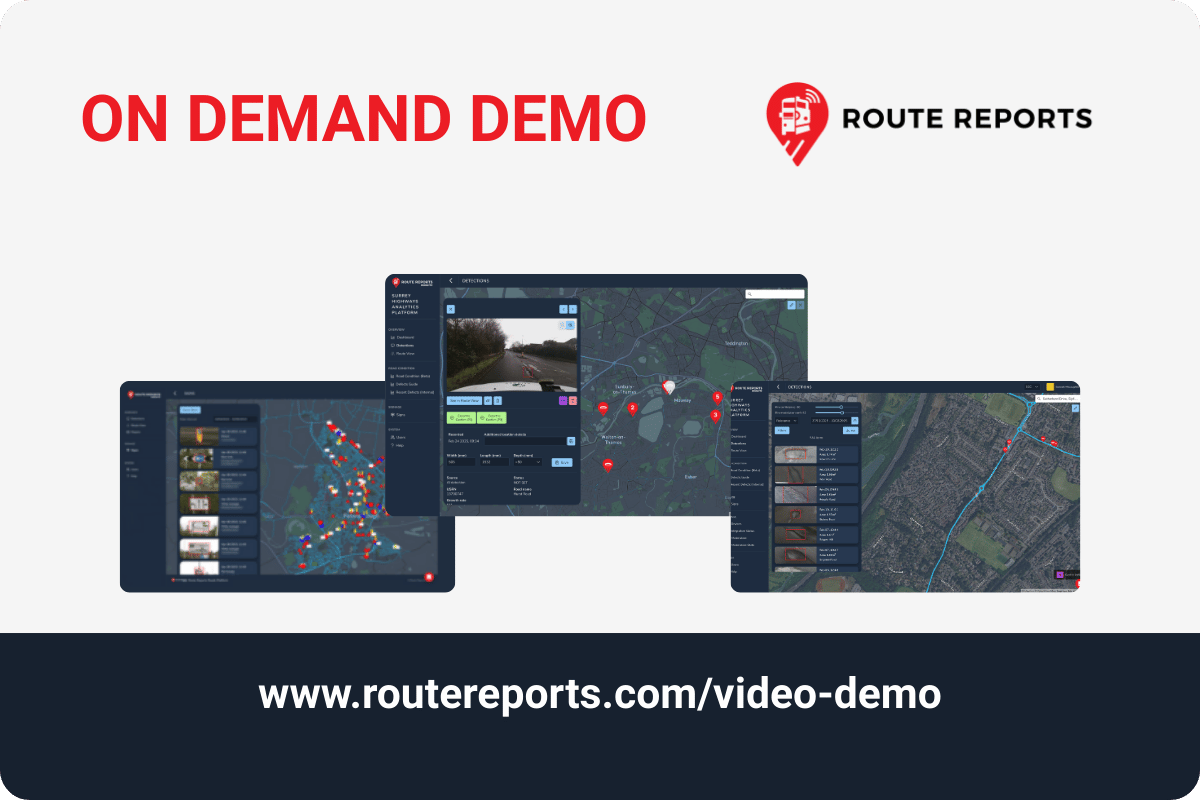
See how Route Reports helps highway teams automate inspections, integrate with existing works management systems and create a seamless workflow from defect detection to repair.
👉 Watch the on-demand demo or contact us today to arrange a one to one with one of our team.